QCinema Industry's Dolly Zoom: Focusing on the wonderful women in film
November 20, 2025
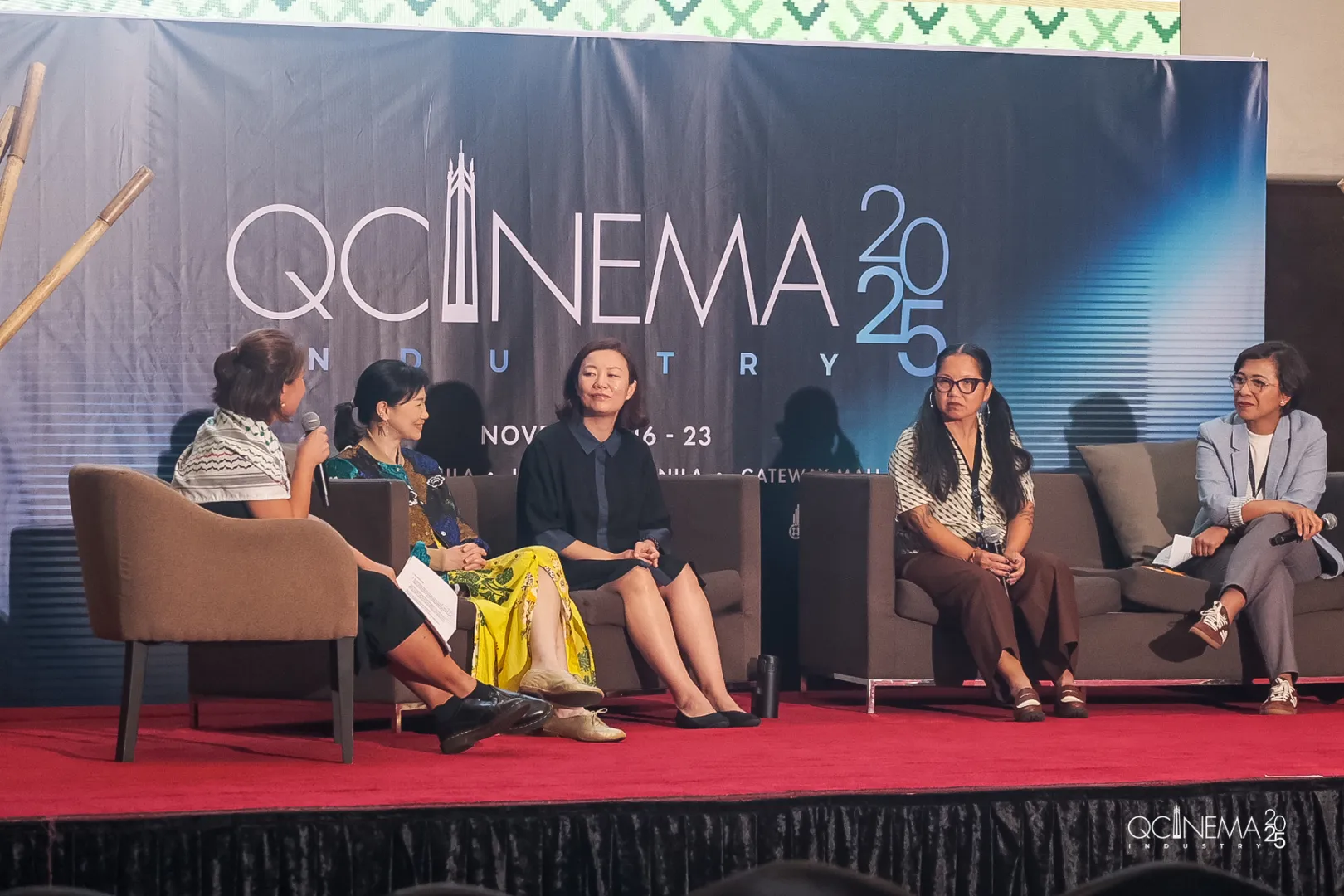
Quezon City, Philippines — The QCinema Industry brought back its Creative Industries Day for the second year in a row this November 19 at Novotel Monet, with the intention of bringing grassroots-led discussions on themes that demand attention from the industry. Bringing gender-inclusivity and feminism at the forefront of today’s topic, Liza Diño joyously shares Quezon City’s becoming a HER CITY. All panelists of Creative Industries were invited to sign the HER CITY Manifesto that details the city’s commitment to keeping and promoting safe workplaces for all identities.
Alongside the inspiring discussion amongst our true film heroines, the QC Film Market continued on its second day lined with an array of exhibitors, among which are Terminal Six Post, Barebones, Inc., Narra Post-Production Studios, and Mocha Chai Laboratories. The constituents flocked the stalls for an opportunity to explore potential partners and secure project funding. Some of the notable booths include Terminal Six Post, Barebones, Inc., Narra Post-Production Studios, and Mocha Chai Laboratories.
The audiences were then taken behind-the-scenes with some of the ladies that make a motion picture possible. Creator of the beloved Leonor Will Never Die, Monster Jimenez, swung in with cinematographer Tey Clamor, French producer Dominique Welinski, and Viet cinematographer Nguyen Phan Linh Dan to take us along their ride as a woman worker in the creative field. As the only female cinematographer in Vietnam, Nguyen Phan expresses her hardships due to the preconceived cultural superstitions about women in her country working in technical fields. There was a pressure to challenge these ideas because it limited her world on set. Clamor anecdotes similarly in the Philippine context where women are kept from handling heavier gadgets, despite coming from a culture of respect. The panelists come to agree on working with a community to help push these conventions to make spaces more accessible to women.
Leading ladies as agents of reel change [Women Leading, Actresses as Agents, Roundtable]
Asian cinema specialist Jeremy Segay meets QCFC’s Liza B. Diño, Jakarta Film Commission’s Vivian Idris, and Asian Film Alliance Network’s Lorna Tee as they share how policy-making in the industry has evolved in sustainability. The speakers disclose how they continue to lead film commissions and festivals towards inclusive city-building around Asia. They acknowledge that the culture is slowly evolving despite existing in a patriarchal society that nurtures non-confrontational traditions to keep the majority comfortable. Diño notes the hesitance in shifting the culture. It’s easier to say “it is what it is” because of what’s been inculcated within for decades, but it is up to this generation to change the next decades to come. They extend the discussion to positions of power, in which Idris presses the need for bureaucrats to invite more creatives into policy-making spaces. As gender representation gains momentum in film, Tee emphasizes the need to extend that representation to more minorities for a chance to be heard in the mainstream. The talk culminated the significance of prioritizing intersectionality when working in positions that can promote cultural visibility. Finally, the women finish off with a piece of advice for those that experience identity-based boundaries: “Take up space”.
Maintaining the energy of the previous panel, renowned Southeast Asian actresses Qymira, Iza Calzado, and Kaity Nguyen engage in a dialogue on shattering stereotypes on screen with moderator and fellow actress Aya Fernandez. The actresses explore the generational bridge that industry women forge for the futures to come. The journey has not always been the easiest for women that have to juggle a balancing act of both authenticity and success. There is a desire to challenge Asian norms that put them in boxes while also pressuring them to become guiding lights of change. Fernandez turns the panel’s attention to gaining control over the stories being told, to which they all have taken the baton from men who have previously told female stories in their perspectives. With time, they hope to become heroines in an organically gender-inclusive society.
Women programmers from across Asia shared an afternoon at the “Curating Global Taste, Building Women’s Voices” Roundtable where they noted how even the smallest programming choices can shape the narrative of a film. Moderator Katrina Tan introduces women programmers Kiki Fung from Hong Kong and Brisbane, Jeonju’s Sung Moon, Filipino-American Irene Soriano, and Rina Damayanti from Jakarta. A woman’s sensibilities are important in film programming, even more when they practice a wide array of disciplines. They touch on the capitalist trend to pump out feminist content for a profit without much of a substance, making sure that they make intentional efforts to still create comprehensive and meaningful movies.
Film management is no easy feat. QCinema Industry invited women in executive studio roles to talk content production in their respective senior positions. Deadline Hollywood’s Liza Shackleton kicks off the discussion on curating global taste and building women’s voices. Joining her are celebrated personalities Bianca Parkes from Neon USA, Madonna Tarrayo of UXS Inc., Epicmedia’s Bianca Balbuena, and Fumie Lancaster from SC Films International. Tarrayo shared how she gains footing in a highly competitive sphere, especially among fellow women trying to cement their place in the industry. Surrounded by the easy success of nepo babies, spearheading as women offers its own unique sets of challenges. However, through their vitalizing success stories, they reveal how women grow to dominate the field.
Liza Diño sits with CNC’s Agnès Toullieux to close the program with a keynote presentation on moralizing the sector to prevent harassment and further analyze the risk factors of women in the industry. “Gender Parity in Cinema” highlighted the modern woman’s position in the contemporary film scene. Toullieux dove into her initiatives that builds an equitable ecosystem that she hopes to extend across countries and cultures.
Finally, to honor the matriarchs that paved Quezon City’s cinematic legacy, a sentimental tribute was presented by QCinema Industry Managing Director Liza Diño in dedication to the great women pioneers. Among them was LVN Pictures Studio’s Doña Narcisa “Doña Sisang” de León, Doña Azucena “Doña Nene” Vera-Perez of Sampaguita Pictures, Regal Entertainment founder Lily “Mother Lily” Y. Monteverde, and Ma. Azucena “Marichu” Vera-Perez Maceda of Movie Workers Welfare Foundation (MOWELFUND) and the Film Academy of the Philippines (FAP).